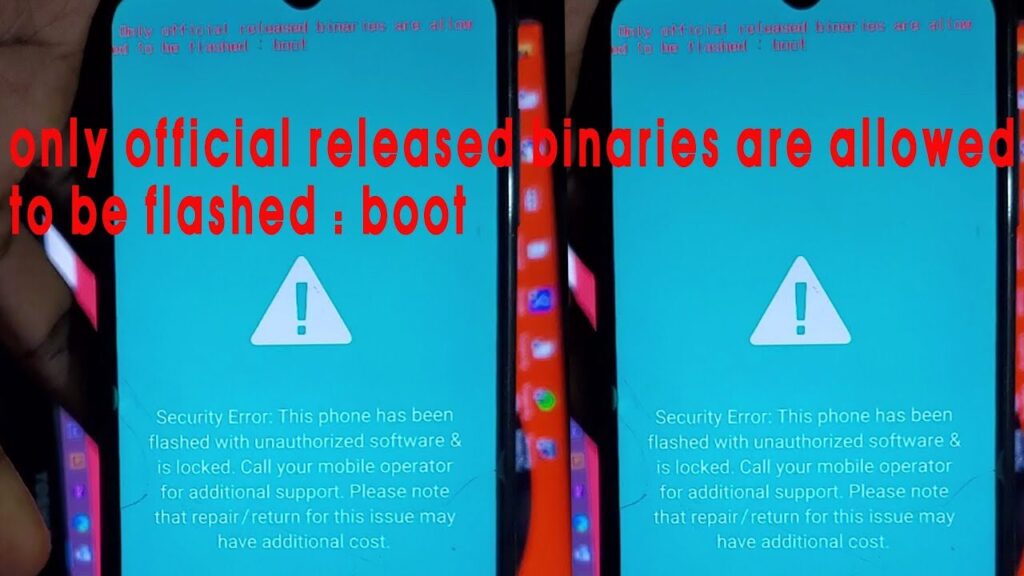
If a Samsung Galaxy phone shows “Only Official Released Binaries Are Allowed”, the device has rejected a software operation because it did not meet the phone’s current security requirements. The warning does not automatically mean the phone is permanently damaged.
Samsung devices use multiple security checks during startup and firmware operations. Depending on the model and software version, bootloader state, firmware compatibility, and device-management restrictions can all affect whether a software operation is accepted.
This warning does not by itself mean that the phone is permanently damaged. The correct response is to identify whether the problem is firmware compatibility, bootloader state, device security, or a hardware fault before attempting another software operation.
What Does the Error Actually Mean?
When Samsung displays “Only Official Released Binaries Are Allowed”, the phone has rejected the firmware because its security verification failed. This usually happens before any system partition is modified, protecting the device from unauthorized changes.
The error may appear with different partition names such as:
| Error Message | Meaning |
|---|---|
| Only official released binaries are allowed (Recovery) | Custom recovery blocked |
| Only official released binaries are allowed (System) | Modified system image blocked |
| Only official released binaries are allowed (VBMETA) | Modified verified boot metadata rejected |
| FAIL! (Auth) in Odin | Authentication failed during flashing |
The exact wording can vary by device and software version. Odin may also stop the operation with an authentication or compatibility failure. The message should therefore be treated as a security or firmware-validation warning, not as proof that one particular component has failed.
Learn more Common Smartphone Mistakes That Damage Your Device
Samsung devices use signed firmware and several security checks during boot and software installation. The requirements for modified software vary by model, region, carrier and software version, so a prerequisite that applies to one Galaxy device may not apply to another.
Why Samsung Devices Display This Warning
Samsung’s security model has evolved considerably over the past several years. Beginning with Android 10 and continuing through One UI 8, the company introduced additional verification mechanisms that make unauthorized flashing much more difficult.
Several security features now work together:
- Knox Secure Boot
- OEM Lock
- Factory Reset Protection (FRP)
- KG (Knox Guard)
- VaultKeeper
- Android Verified Boot (VBMETA)
These technologies continuously verify whether the firmware being installed has been digitally signed by Samsung. If even one verification fails, the flashing process stops immediately.
Some Samsung devices may show a security state that restricts software modification. The exact behavior varies by model, region, carrier, and software version, so the displayed device information should be checked before attempting another flash.
Common Causes of the Error
When the message “Only Official Released Binaries Are Allowed” appears, it is not random. It is triggered by specific security conditions inside Samsung’s firmware protection system. Understanding these causes is the key to fixing the issue without guessing or repeatedly flashing files that won’t work. In 2026, Samsung’s security stack has become even stricter, meaning even small mismatches can block flashing instantly.
Locked Bootloader
A locked bootloader is the most common reason behind this error. The bootloader is like the gatekeeper of your phone’s operating system. If it is locked, the device will only accept firmware that is officially signed by Samsung. Any attempt to install custom recovery, patched boot images, or modified firmware will be rejected immediately.
On many Samsung devices, especially carrier-locked models, the bootloader cannot be unlocked at all. Even global models require enabling OEM Unlock before flashing anything unofficial. If this step is skipped, Odin will fail and trigger the binary restriction error. In simple terms, a locked bootloader is like a security guard refusing entry to anything not on the approved list.
OEM Lock Enabled
The OEM Lock setting inside Developer Options is another major factor. When OEM Lock is turned ON, the device actively blocks bootloader modifications and unauthorized firmware flashing.
Many users unknowingly leave this enabled when trying to flash firmware using Odin. Even if the correct firmware is used, the system still rejects it because the device is in a protected state. In newer Samsung updates, OEM Lock can also re-enable itself after a factory reset or long inactivity period, which confuses many users who previously had flashing access.
KG / RMM Prenormal State
One of the most frustrating triggers is KG (Knox Guard) or RMM state set to “Prenormal.” This security condition is designed to prevent tampering shortly after a device reset or activation.
A restricted KG or device-management state can limit bootloader modification on supported Samsung devices. The exact states and behavior vary by model, region, carrier and software version, so Download Mode information should be checked for the specific device rather than relying on a fixed waiting period.
Do not assume that a particular number of days, SIM-card requirement, or network procedure will change the security state. If a restricted state is displayed, follow Samsung’s supported device and account procedures and avoid tools that claim to remove the restriction by bypassing security controls.
Device ownership and security checks
Account and ownership protections can restrict actions on a reset device. If a phone belongs to someone else or is managed by an organisation, use the legitimate account or administrator process rather than attempting to bypass the protection.
In FRP-locked devices, Samsung restricts unauthorized firmware changes to prevent bypass attempts. Even if Odin recognizes the device, it may still block flashing and display the binary restriction error.
Before working on a second-hand device, make sure ownership has been transferred correctly and that the previous owner’s account has been removed through the normal device settings.
Incorrect or Incompatible Firmware
Another overlooked cause is simply using the wrong firmware package. Samsung firmware is highly specific. It must match:
- Exact model number (e.g., SM-A057F vs SM-A057M)
- Region/country code (CSC)
- Bootloader version (binary revision)
Firmware compatibility must be checked carefully before flashing. A Samsung device generally cannot be downgraded to a firmware package with an incompatible bootloader revision, and other mismatches can produce different errors. Check the exact model and firmware information for the device before proceeding.
Even experienced technicians sometimes make this mistake when mixing firmware versions across regions.
How to Fix “Only Official Released Binaries Are Allowed”
Fixing this error depends entirely on identifying the root cause. There is no universal single-click solution, but there is a reliable step-by-step approach that works in most cases.
Flash Official Samsung Firmware
For a device that is eligible for firmware recovery, the appropriate approach is to use the manufacturer’s supported firmware and a compatible Samsung service or flashing procedure. If Odin is used by a technician, verify the exact model, firmware revision and device state first.
Start by downloading the exact firmware for your model from a trusted source. Ensure the binary version matches or is higher than the installed one. Then:
- Boot device into Download Mode
- Open Odin on PC
- Load BL, AP, CP, and CSC files
- Start flashing without modifying any settings
If the device is not modified beyond recovery, this method restores normal functionality and removes the error. It also resets corrupted partitions that may be blocking boot validation.
Enable OEM Unlock (If Available)
If the device and its regional variant support bootloader unlocking, the relevant OEM-unlock setting may be available in Developer Options. This setting is not required for ordinary installation of matching official firmware, and availability varies by device.
To do this:
- Go to Settings > Developer Options
- Enable OEM Unlock
- Reboot the device
If the setting is missing or unavailable, do not assume KG Prenormal is the only explanation. Device variant, region, carrier restrictions, account state and current software can all affect whether bootloader unlocking is offered.
Check KG Status
Some Samsung Download Mode screens display security-state information. If such information is shown, record it before making changes and compare it with the requirements for the exact device model.
- KG STATE: NORMAL → the device is not reporting the restricted KG state shown above; other security or compatibility requirements may still apply.
- KG STATE: PRENORMAL → bootloader modification may be restricted; the exact behavior depends on the device and software version.
If a restricted security state is shown, use supported Samsung procedures and do not attempt to bypass the restriction with unofficial tools. There is no reliable universal waiting period that applies to every Samsung model.
Update Odin Tool
Flashing failures can also result from using an incompatible or unsupported flashing environment. Rather than choosing a tool solely because it is newer, use the procedure and software version appropriate for the exact device and firmware generation.
If Odin is part of the supported repair workflow for the device, use a version and setup appropriate for that model and firmware generation. Do not treat an Odin update as a universal fix for a security-state or firmware-compatibility error.
Preventing the Error in the Future
Avoiding this issue is easier than fixing it. Most users encounter it because they rush into flashing without checking prerequisites.
Best Practices Before Flashing
Before using Odin or any flashing tool:
- Always check model number twice
- Confirm bootloader version compatibility
- Verify KG and OEM status
- Ensure battery is above 60%
- Use original USB cable and stable USB port
Skipping these steps significantly increases the chance of triggering security blocks.
Verify Firmware Compatibility
Never mix firmware from different regions unless you fully understand CSC behavior. Samsung devices are highly sensitive to mismatched regional software.
A good rule is simple: always match firmware exactly to your device model and region. Even small differences can cause authentication failure during boot verification.
Frequently Asked Troubleshooting Questions
Can the Phone Be Recovered?
Recovery depends on the cause. A phone that still enters a supported recovery or Download Mode may be recoverable with the correct official software procedure, while persistent authentication failures, bootloader problems, or hardware damage may require professional service.
Is Data Lost?
Yes, flashing firmware usually wipes user data, especially when using CSC instead of HOME_CSC. Always back up before attempting fixes.
When Professional Repair Is Needed
If the device remains stuck in Download Mode with repeated authentication failures even after flashing correct firmware, professional service may be required.
Conclusion
The “Only Official Released Binaries Are Allowed” error is not a random failure but a deliberate Samsung security mechanism. It protects the device from unauthorized modifications, but it can be frustrating when triggered unexpectedly. Most cases are linked to bootloader restrictions, KG state, OEM lock, or incorrect firmware usage.
Once you understand the device’s security state and firmware requirements, the warning becomes easier to diagnose. The appropriate solution may be as simple as using compatible official firmware, but a restricted bootloader, account-management state, or hardware fault may require a different supported repair path.
FAQs
1. Why does Odin show “Only Official Released Binaries Are Allowed”?
This happens when Samsung security blocks unofficial or incompatible firmware from being flashed.
2. Can I bypass KG Prenormal mode?
Do not attempt to bypass a restricted KG state. Follow the supported procedure for the specific Samsung model and software version; there is no universal method or guaranteed waiting period that applies to every device.
3. Does flashing official firmware remove the error?
It can, when the device accepts the matching official firmware and the underlying cause is a firmware or validation problem. A security-state restriction will not necessarily be resolved simply by flashing another package.
4. Why is OEM Unlock missing?
A missing or unavailable OEM Unlock option can have several causes, including device variant, region, carrier restrictions, account state, or other security conditions. It should not automatically be attributed to KG or FRP.
5. Is this error a sign of a bricked phone?
The warning alone does not prove that the phone is bricked. If the device still enters Download Mode or Recovery Mode, its recovery options depend on the exact model, software state and hardware condition.


Join the Conversation
Have a question or insight to share? Add your thoughts below.